Guided by the feedback that you provided us at the Sparks 25 gathering last October, we wanted our SUMA session to initiate the first of several conversations with elected officials and municipal administrators; inviting them to join us on our collective journey of reimagining community recreation and parks.
This journey is driven by a common interest in: Creating a Saskatchewan where everyone belongs and has access to recreation and parks, where we truly understand the connection to health and wellbeing, and where everyone not only values, but invests in recreation and parks for the greatest public good.
 Research Findings
Dr. Jackie Oncescu
Research Findings
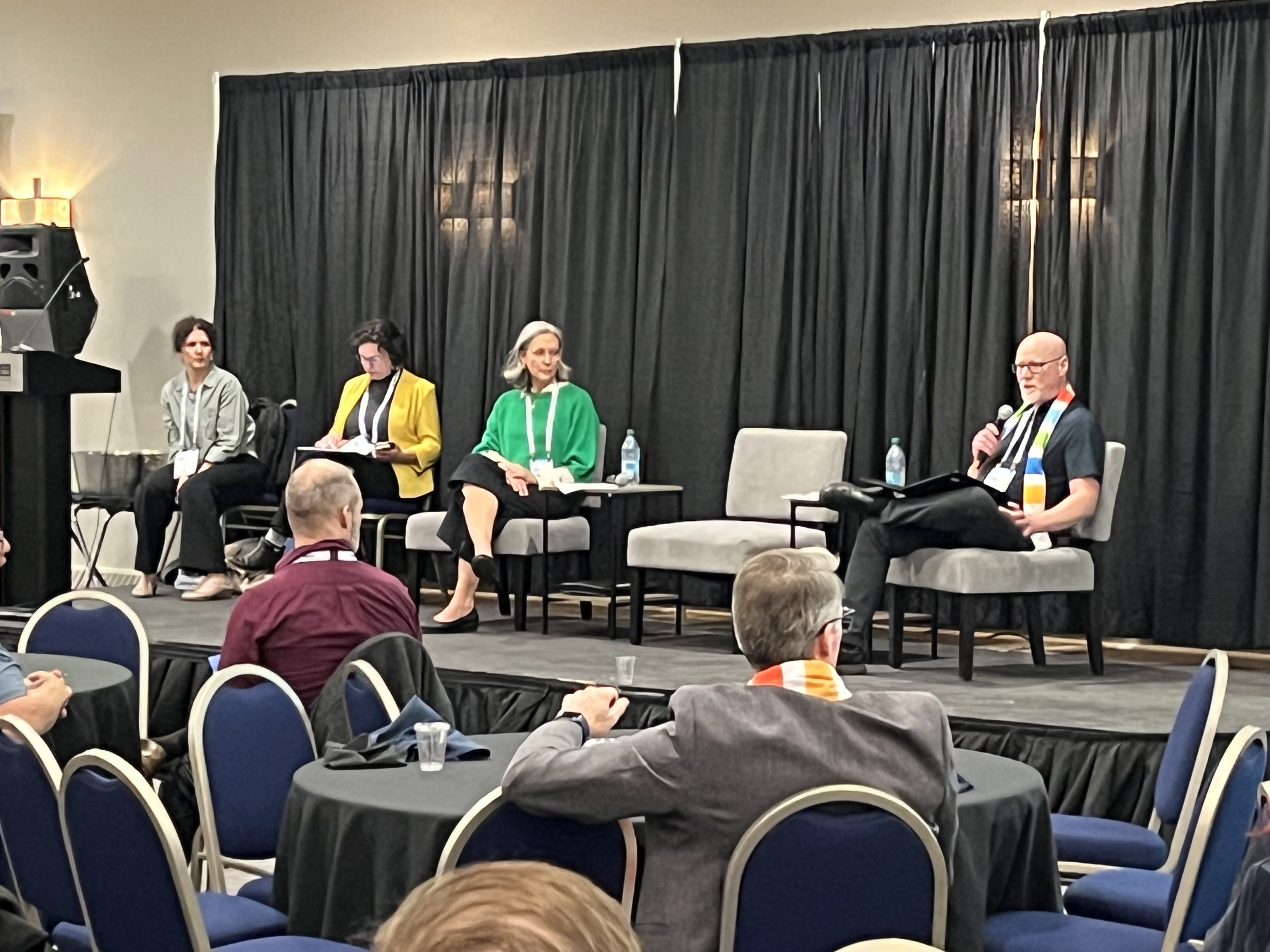
Dr. Jackie Oncescu, Rachel Bedingfield and I began our SUMA session by sharing some Saskatchewan-specific data gathered through aligned partners like the
Canadian Fitness and Lifestyle Research Institute and
Sask Wellbeing. This research uncovered a few surprising points – some that are encouraging, and others that are cause for concern.
What’s working? 91% of adults in Saskatchewan said that they had indoor sport and recreation facilities in their community*; and 82% of Sask residents have visited a park or green space close to their home**. Both numbers are higher than national averages, which is great.
What’s concerning? 35% of adults in Saskatchewan don’t feel a sense of belonging in the community where they live, and this number has been increasing since 2020***. Additionally, and surprisingly, 73% of adults in Saskatchewan said that they never or rarely use indoor sport and recreation facilities*.
Responses to Societal Realities
Since the inception of the recreation movement across Canada in the 1940’s, parks and recreation has responded to the societal pressures of the day – in the 40’s there was a focus on physical fitness driven by war efforts; between the 50’s and 70’s there was an increase in infrastructure and programs as a result of demands associated with the baby boom.
The recession of the 80’s and 90’s forced a shift to focus on cost recovery and the benefits of recreation. Since the 2000’s, there has been a further imbedding of the sport and tourism market-driven, transactional pay-to-play model into parks and recreation systems that still exist today.
The Covid-19 pandemic, population demographics, and increased social complexity in communities are influencing our day-to-day operations. Although the economy is still a driving factor in how we operate as an industry, an opportunity exists to reimagine how recreation and parks services can evolve and respond to changing realities.
Parks and Recreation as Relational Infrastructure
As a result of this history and demonstrated our industry’s ability to adapt, the current operating system for parks and recreation is overwhelmingly transactional – focused on service delivery, asset and facility management, participation numbers, and budget pressures.
But, as heard at Sparks 25, there is a genuine interest in exploring a different way for recreation and parks to exist and contribute to overall quality of life within communities.
This conversation continued at SUMA, where our session brought reflections from municipal leaders. It came with an invitation to engage with their communities on how parks and recreation are most often discussed, prioritized, and acted upon and consider questions like,
“Does our community council:
- talk about recreation and parks primarily as services and facilities, or as contributors to community wellbeing and belonging?
- focus on what we deliver (programs, amenities and infrastructure), or what changes for people and the community?
- frame recreation and parks as a discretionary service, or as an essential or core service?
- hear from residents who are already engaging in parks and recreation services we provide, or those who are often excluded from those services?”
The Invitation
If you feel as though your community may be ready to explore what a shift from transactional to relational approaches could look like, we’d love to hear from you at
office@spra.sk.ca. Your interest will help guide us on what our next actions will entail, so we look forward to hearing from you.
Sources
* Statistics Canada and Canadian Fitness and Lifestyle Research Institute. Custom tabulation from 2023 Social, Health, Economic, and Environment Study. CFLRI, Ottawa, Ontario, Canada.
**Canadian Fitness and Lifestyle Research Institute (CFLRI), Canadian Parks and Recreation Association (CPRA) and Raymond Chabot Grant Thornton (RCGT). 2025. Measuring the Impact of Sport, Physical Activity, and Recreation in Canada. CFLRI, CPRA & RCGT. Ottawa, ON, Canada.
***Smale, B. (2025). Data and Trends in Wellbeing in Saskatchewan and Canada from 1994 to 2022. A Technical Report. Prepared for Heritage Saskatchewan and Community Initiatives Fund. Waterloo, ON: Canadian Index of Wellbeing and the University of Waterloo.